


Two-Component Tooling
Two components need a mould that handles both: we design and build multi-component moulds in house – engineered for reliable bonds and stable series processes.

Two-component moulds explained
A two-component mould is an injection mould in which two plastic components are processed one after the other within a single machine cycle. It differs from a single-component mould through a second gating system, a mechanism for transferring the pre-moulded part and separately controlled cooling circuits. These additional functions increase design effort considerably – in return, the finished part is created without a subsequent assembly step.
Certified processes
ISO 9001 and IATF 16949. We meet the quality requirements that automotive and electrical engineering customers place on their mould suppliers – from documentation through to traceability.
Mould making in house
Design and manufacture of the two-component moulds happen here, not at a supplier. Changes arising from coordination feed straight back into the design.
Mould and series at one site
Sampling and series production run at the same location on more than 5,000 m². If corrections are needed, they are made in house – without shipping, without company boundaries.
Structure of a two-component mould
A mould for multi-component moulding has to serve two cavities at once and transfer the pre-moulded part precisely between the two stations. Four features distinguish it from a conventional injection mould – and each one is a decision taken before design begins.
Single-component mould
- One gating system
- One cavity, one material
- One cooling circuit
- Simple ejector system
Two-component mould
- A second gating system per component
- Transfer mechanism for the pre-moulded part
- Separate cooling circuits
- Station-dependent ejector system
Second gating system
Each component needs its own gate. Both systems are designed separately because the materials have different flow properties and processing temperatures. With a hot runner version, separate control per component is added.
Transfer mechanism
After the first shot, the pre-moulded part has to reach the second cavity – depending on the mould concept via a rotary platen, an index plate or a transfer unit. This mechanism determines cycle time, mould size and the demands placed on the machine.
Separate cooling circuits
Hard and soft components usually require different mould temperatures. If both areas are served by the same circuit, either the forming or the finished part suffers. Cooling is therefore not a side aspect of the design but determines which process window is available in series production at all.
Station-dependent ejector system
In the first station the pre-moulded part is not demoulded but held and transferred – ejection only follows after the second station. The mould therefore needs two separately controlled ejector functions. This is the point at which series stability is decided.
Three ways to combine two components
Which mould concept makes sense depends on part geometry, quantity and the available machine. We select it together with you before design begins.
Rotary platen mould
The moving mould half sits on a rotary platen that swivels the pre-moulded part 180 degrees into the second station. Robust, fast in cycle and well suited to higher quantities.
Index plate mould
A rotating centre plate carries the pre-moulded part to the second cavity. The concept allows more complex geometries than the rotary platen and requires no machine with a rotary platen unit – provided a second injection unit is available.
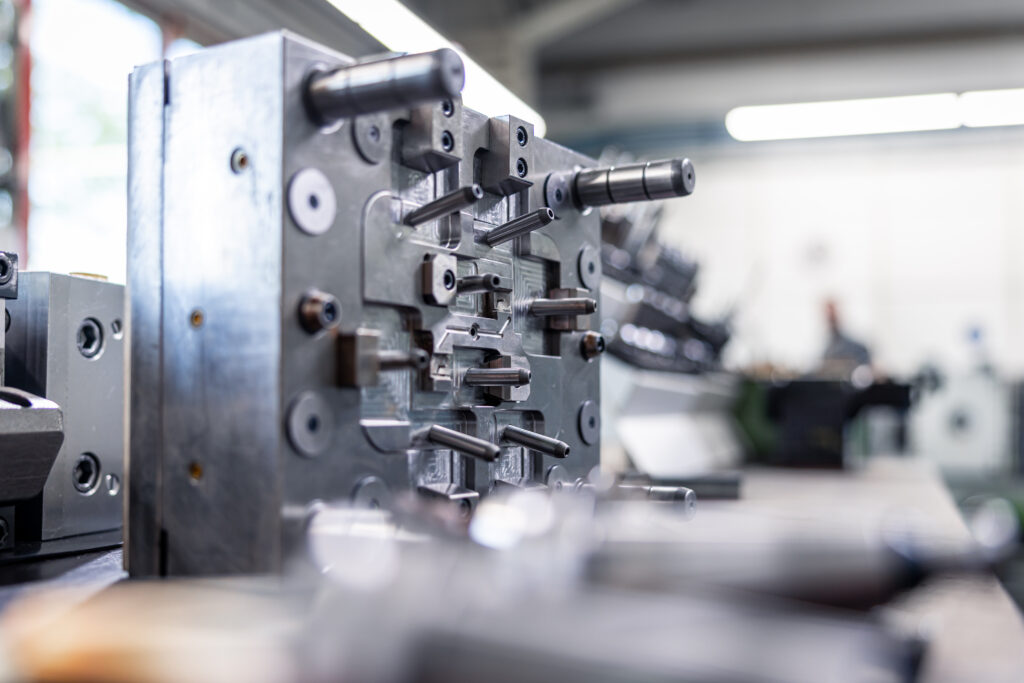
Transfer process
The pre-moulded part is removed and inserted into a second mould or a second cavity – manually or by handling equipment. Mould effort stays low, but cycle time increases.
Where two-component moulds fail – and why
Most problems in multi-component moulding do not arise in the machine but long before, in the mould. Four points determine the outcome.
Adhesion between the components
Not every material pairing bonds chemically. Where chemical adhesion is missing, the bond has to be created mechanically – through undercuts, openings or encircling grooves. That is a mould decision, not a material decision.
Differing shrinkage
Hard and soft components shrink to different degrees. If this is not accounted for when designing the cavities, the part warps or the soft component detaches at the edges.
Position of the parting line
The parting line must be positioned so that the pre-moulded part is held securely during transfer and the second component moulds on cleanly. An unfavourable parting line can hardly be corrected later.
Temperature control
The soft component is usually moulded onto an already cooled pre-moulded part. If it is too cold, adhesion suffers; if it is too warm, it deforms. The window in between is set by the cooling system.
We clarify these points in the feasibility assessment, before the first drawing is produced. Details on the process itself can be found on our page about two-component moulding.
A critical detail on your part?
Send us the geometry – we will tell you whether and how it can be solved in the mould.
Mould and series from a single source
At Schröder + Heidler, two-component moulds are built in our own mould making department – and then start up in our own production. This shortens the paths between design, mould making and sampling: if the first shots reveal a need for correction, the mould is adjusted in house, without shipping and without coordination across company boundaries.
Since 1991 we have been manufacturing injection moulds and plastic components in the Saxon Erzgebirge for customers in the automotive, electrical engineering, consumer goods and mechanical engineering sectors. Today more than 115 employees work on over 5,000 m² of production space – mould making, injection moulding, two-component technology and subassembly assembly at one site.
Our processes are certified to ISO 9001 and IATF 16949. This means we meet the requirements that automotive and electrical engineering customers place on their mould suppliers – from sampling-ready documentation through to traceability in series production.
From enquiry to production mould
You do not need a finished specification for a first response. A drawing or a CAD data set is enough to assess feasibility and mould concept.
Enquiry
You send us a drawing or CAD data, along with materials, quantity and target market as far as these are known.
Feasibility and mould concept
We review material pairing, parting line and transfer principle and recommend a rotary platen, index plate or transfer process – with reasons.
Design and mould making
Mould design and manufacture run in house. Changes arising from coordination feed straight back into the design.
Sampling and production start-up
The mould is sampled in our own production. Corrections are made in house – without shipping and without coordination across company boundaries.
What two-component moulds are built for
Three part categories cover the majority of enquiries reaching us from the automotive, electrical engineering, consumer goods and mechanical engineering sectors. What matters in each case is what the mould has to achieve – not what the part looks like.
Seal on a housing
An engineering thermoplastic carries the function, a thermoplastic elastomer forms the encircling sealing geometry. The assembly step for a separate seal is eliminated, as is the tolerance chain between two parts.
Grip and control surface
The soft component is moulded onto the hard body as a grip surface or keypad. Besides the feel, the clean edge between the two components counts – it is a visible quality feature on the end product.
Part with two functional areas
A hard-hard combination, for example for two colours or two differently formulated materials in one part. Without chemical adhesion, the bond is created mechanically through the mould geometry.
Frequently asked questions about two-component tooling
A two-component mould is an injection mould in which two plastic components are processed one after the other within a single machine cycle. The pre-moulded part from the first component is transferred inside the mould into a second cavity and overmoulded there with the second component. The result is a finished part without a subsequent assembly step.
It has a second gating system, a mechanism for transferring the pre-moulded part, separately controlled cooling circuits and a station-dependent ejector system. Design and manufacture are therefore more demanding than for a conventional injection mould.
The rotary platen is the most economical for high quantities and simple geometries. The index plate suits more complex parts with tight tolerances. The transfer process keeps mould effort low and pays off for small and pilot series, or when both components require very different process windows.
Common are hard-soft combinations of an engineering thermoplastic and a thermoplastic elastomer, as well as hard-hard combinations for parts with two colours or two functional areas. What matters is whether the materials bond chemically – otherwise the bond is created mechanically through the mould geometry.
Do you have a two-component part in design?
Send us your drawing or CAD data. We will assess feasibility, recommend a mould concept and come back with a reliable appraisal. Your documents are treated confidentially.